EN
EN  English
 русский
 عربى
عربى 中文简体
中文简体
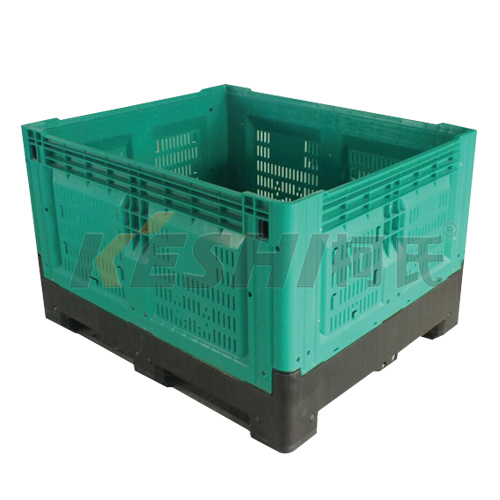
A plastic pallet box holds hundreds of kilos of produce, industrial parts, or bulk liquid. Forklift tines slide under it. Empty containers nest together. A pallet container mould produces these large-format parts in presses closing with hundreds of tons of force. The cavity spans a square meter or more. The part weighs up to twenty kilos. The mould runs for a decade. A pallet container mould manufacturer builds tooling for agricultural supply chains, food processors, and industrial bulk shippers.
Filling a Cavity Measured in Meters, Not Millimeters
The mould cavity matches a standard pallet footprint, roughly 1200 by 1000 millimeters. Side walls rise several hundred millimeters. Molten HDPE or polypropylene fills this volume through a hot runner system with multiple valve gates. Each gate opens in sequence so the melt front pushes across the cavity evenly. A pallet container mould with sequential valve gating keeps weld lines out of structural areas.
The injection unit pushes a shot volume measured in liters. Clamp tonnage has to resist the injection pressure spread across the entire projected area. A mould designed for the right press size avoids flashing at the parting line. Wall thickness transitions from the solid base to the ribbed walls need generous radii. Sharp corners create stress risers that crack under load.
Cooling Twenty Kilos of Plastic Fast
Cycle time depends on pulling heat out of the thick sections. Cooling channels run through the core, cavity, and stripper plate. The channels are sized for turbulent flow and fed by a chiller or mould temperature controller.
The thickest areas, pallet feet, corner posts, stacking rim, hold the most heat. A pallet container mould with conformal cooling in these zones pulls heat faster than straight drilled channels. Uniform cooling on both mould halves prevents warpage. A container that cools unevenly twists. A twisted container does not stack or sit flat on racking.
Here is what the mould needs for production:
- Sequential valve-gated hot runner system for complete fill
- Clamp tonnage matched to projected area and injection pressure
- Conformal cooling in feet, corners, and stacking rim
- Stripper plate or large-area ejector pads, not pins alone
- Draft angles of one to two degrees for release
- Automated part removal integrated into the mould design
Demolding Without Damaging the Part
The container shrinks onto the core during cooling. A stripper plate or large ejector pads push on the perimeter of the rim. Ejector pins alone punch through the hot base. The ejection stroke clears the full container height. A robot grips the part and places it on a cooling fixture. The mould is designed for automated removal, no operator intervention needed.
A Decade of Containers
Agricultural supply chains move bulk harvest in these containers. Food processors handle ingredients and liquids. Industrial users ship heavy parts between plants. The container takes forklift impacts and outdoor storage. The mould that makes it has to hold dimensions through millions of cycles.
Valve gates wear. Cooling channels scale up. A pallet container mould with accessible manifolds, replaceable gate inserts, and a preventive maintenance schedule runs for its full design life. Choose a manufacturer that fills the cavity completely, cools the thick sections fast, and ejects without distortion. The containers will stack, nest, and survive the supply chain. That is the output that matters.